


Art Story: Jigsaw Puzzle Game
ARTHUR PEI
Art Story: Jigsaw Puzzle Game is the kind of puzzle game I open when I want my attention occupied without turning the session into a competition. Its central appeal is easy to understand: assemble artwork, settle into a calmer rhythm, and let the image gradually become complete. After spending time with it, I found that its success depends less on a complicated rule set and more on how well the visual presentation supports that quiet concentration.
That makes it a different proposition from a fast match-three game or a puzzle built around timers and escalating pressure. I would recommend it to someone who enjoys visual detail, patient progress, and short reflective breaks. I would not choose it for a player looking for deep strategy, dramatic story development, or a demanding test of speed. The experience is deliberately gentle, and that gentleness is both its strongest quality and its main limitation.
A calm first impression with a clear purpose
The game comes from ARTHUR PEI and sits in the puzzle category, with a free entry point that makes it simple to try before deciding whether it belongs in your regular rotation. Its age rating is Everyone, so the presentation is approachable rather than built around mature themes or intense action. The current version is 3.3, and it supports devices running Android 7.0 or later.
My first impression was that the game understands its own scale. It does not need to pretend to be a large adventure. Instead, it presents puzzle completion as the destination. That focus matters because many mobile games surround a simple activity with layers of menus, currencies, missions, and interruptions. Here, the artwork is the reason to stay, and the puzzle is the way you spend time with it.
The free download is useful for casual players who are unsure whether this style will hold their attention. There are in-app purchases ranging from $1.99 to $99.99 per item, so I would approach the optional spending carefully and decide in advance how much the relaxing experience is worth to me. The game is most appealing when the purchase system remains secondary to the act of solving. Anyone who dislikes optional purchases appearing around a simple pastime should inspect the available choices before settling in for longer sessions.
Related News





The public response is encouraging: the game has a 4.7 average from around two thousand ratings, with over one hundred thousand installs. I see those figures as a sign that its straightforward mood connects with a sizeable audience, not as proof that every player will enjoy it. A person who finds traditional jigsaws satisfying will probably understand the attraction quickly. Someone who needs constant novelty may feel that the pace is too restrained.
Why the opening minutes matter
A good first session with this type of game should not feel like homework. I found it helpful to begin with the intention of completing only part of an image rather than treating the first puzzle as a challenge to finish immediately. That small change in expectation makes the experience more comfortable. The game works best as a pause between activities, not necessarily as a single sitting that demands a large block of free time.
There is also a practical advantage to the familiar jigsaw format. I do not have to learn a complicated control scheme before understanding what I am doing. The mental effort goes toward recognizing colors, edges, patterns, and relationships within the artwork. That low barrier is valuable when I am tired or want something quieter than a conventional game.
Gallery
Artwork as the game’s world language
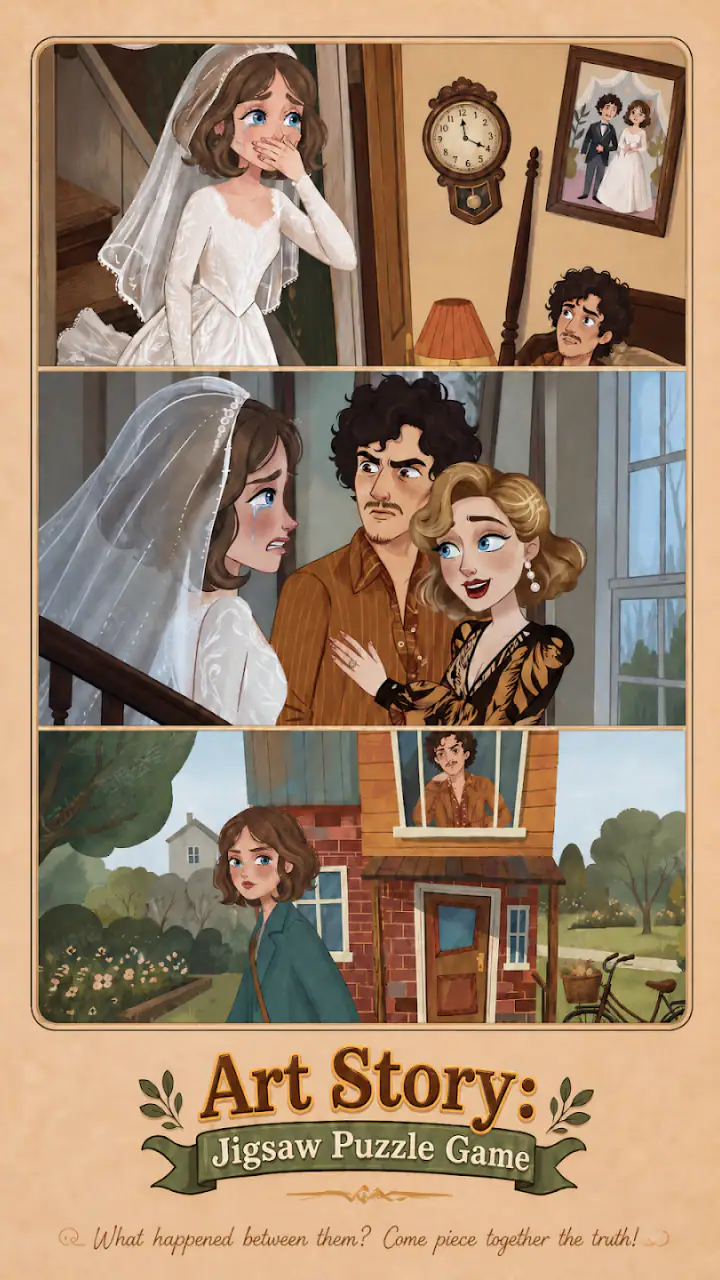
The art direction is not decoration placed behind the mechanics; it is the main language of the experience. Each completed section gives the puzzle a sense of place and identity, while every loose piece asks me to study the image more closely. I pay attention to repeated colors, changes in texture, and the direction of visual lines. In that way, the artwork turns a basic matching task into a slow reading exercise.
This is where the game separates itself from generic puzzle grids. In a match-three title, the board is usually something I clear and replace. Here, the board represents an image I am trying to understand. The reward is not only progress but recognition: a shape that looked meaningless becomes part of a larger scene. That shift creates a more contemplative mood and gives the finished picture a sense of arrival.
I especially like the way a detailed image can change the pace of play. Areas with strong contrast are easier to approach because the pieces have obvious visual clues. Softer regions, similar colors, and broad backgrounds require more patience. Rather than seeing that as a flaw, I treat it as the game’s natural ebb and flow. The artwork determines whether I move quickly or slow down, so the visual design directly controls the emotional temperature.
A useful technique is to avoid sorting pieces only by color. I look for edges, recognizable marks, changes in brightness, and the direction of lines before trying to match a piece. This is more reliable when an image contains large areas that appear almost identical. It also makes the process feel less random, because I am building a small visual theory of the picture instead of guessing repeatedly.
What the setting does well
The setting is effective because it stays focused on the artwork rather than competing with it. I do not need an elaborate fictional world to justify the activity. The images provide the setting, and the gradual reveal supplies the sense of movement. This is a modest form of storytelling, but it suits a game designed for relaxation. The completed image becomes the destination, while the scattered pieces represent the journey.
That approach will not satisfy players who want characters, dialogue, exploration, or a narrative with twists. Art Story: Jigsaw Puzzle Game is closer to a digital gallery that I interact with than a story-driven adventure. The title’s idea of “story” is best understood as the feeling of uncovering an image over time, not as a conventional plot with scenes and character arcs.
For a realistic everyday use case, I can imagine opening it after commuting home, while waiting for an appointment, or during a quiet evening when I want to put my phone to work without absorbing a stream of urgent notifications. A few completed sections can provide a clean stopping point. I do not have to remember a complicated strategy when I return, because the visual clues bring me back into the puzzle.
Sound and rhythm shape the mood
The strongest atmosphere comes from the relationship between visual concentration and pacing. A jigsaw naturally creates a slower rhythm than games based on rapid taps, and the artwork reinforces that tempo. I found myself spending more time looking than acting. That is important: the game’s mood is created not just by what I do, but by the pauses between decisions.
Sound also matters in a puzzle built around quiet attention. I prefer to treat the audio as part of the background rather than the main event. If I want the most restful session, I keep the surrounding environment calm and avoid adding another demanding source of stimulation. The game’s appeal is strongest when the sound, image, and piece placement leave room for concentration instead of pushing me toward urgency.
The pacing is forgiving compared with timed puzzle alternatives. There is no need to rush through a board simply because a clock is counting down. That makes the game suitable for people who enjoy careful observation or who become frustrated when a mobile title punishes hesitation. It also means the experience lacks the adrenaline spike that gives arcade puzzles their appeal. The trade-off is clear: less pressure, but also less excitement.
I think of each session as having three phases. At first, I scan the image and identify obvious anchors. Then I enter a slower middle stretch, where similar pieces demand closer inspection. Finally, once enough of the picture is connected, the remaining placements become easier because the visual context is stronger. Recognizing this rhythm helps me avoid interpreting the difficult middle section as a sign that I am playing badly. It is simply where the image asks for more attention.
Using the rhythm instead of fighting it
My best practical tip is to stop at a natural visual breakpoint rather than forcing completion. If I have already spent several minutes comparing pieces with nearly identical colors, a short pause can be more useful than repeated guesses. Returning with fresh eyes often makes a boundary or pattern easier to notice. This is one of the game’s less obvious strengths: stepping away does not feel like failure because the experience is not built around a race.
Another helpful habit is to change the type of attention I use. When I am stuck, I stop searching for a perfect color match and look for geometry: a straight edge, a corner, a curve, or a line that continues into a neighboring section. On a visually rich image, shape relationships can provide better guidance than color alone. This turns the puzzle into a sequence of small observations rather than one large problem.
That method also reveals a limitation. If a player wants the game to provide constant, explicit direction, the relaxed rhythm may feel under-explained. The pleasure comes from noticing connections independently. I would choose a more guided puzzle app for a child or beginner who needs frequent instruction, while I would choose this one for someone who enjoys a little quiet uncertainty.
How the mechanics fit the artistic idea
The mechanics work because they support the art instead of trying to overshadow it. Every action has a visible purpose: identify a piece, place it, and improve the clarity of the image. There is no need for a separate combat system, resource strategy, or complicated progression model to make the activity meaningful. The simple interaction allows the artwork to remain in control of the session.
That simplicity is also why comparisons with other puzzle games need some care. Compared with match-three games, this is less about chain reactions and more about sustained observation. Compared with word puzzles, it depends less on language and more on visual memory. Compared with physical jigsaws, it is more convenient and easier to start, although it cannot reproduce the tactile sensation of handling real pieces on a table.
I would choose this game over a competitive puzzle when I want to relax, but I would choose a logic puzzle when I want to feel challenged by deduction. I would choose a physical jigsaw when I have a table, time, and a preference for tangible pieces. The digital format wins on convenience and immediate access, while the physical alternative offers a different kind of presence that a phone screen cannot provide.
The mechanics are particularly suitable for short, interrupted sessions. If I need to put the phone down, the puzzle’s visual state gives me a clear memory of where I was working. That makes it more forgiving than a fast action game, where losing concentration for a moment can undo progress. It is also a good fit for people who like to make gradual progress without feeling that every session must produce a high score.
Where the design may not fit
The same calm structure can become repetitive if I play for too long without a break. Because the core activity remains consistent, the game does not offer the mechanical variety of a larger puzzle collection. Players who need new rules, increasingly complex systems, or strong challenge escalation may run out of reasons to continue sooner than players who value the artwork itself.
The free-to-try model is convenient, but optional purchases deserve attention. A player who wants a completely uninterrupted experience should consider whether the available items fit their personal budget before buying. I would not spend simply to remove the feeling of being stuck; I would first use a pause, a different visual clue, or a shorter session. The game is most rewarding when progress feels observed and earned rather than hurried.
Device compatibility is also straightforward for many users because Android 7.0 is an established minimum, but anyone using an older phone should check compatibility before planning around it. On a supported device, the important question is not raw power so much as whether the screen is comfortable for examining artwork. A larger display can make subtle details easier to compare, while a small screen may encourage shorter sessions.
The game is suitable for an Everyone audience, but that does not mean it is equally suited to every age or attention style. Younger players may enjoy the artwork and matching process, while adults may value it as a quiet decompression tool. A person who prefers direct goals and immediate rewards might find the slow reveal less satisfying. Knowing that before downloading is more useful than assuming every puzzle game offers the same kind of engagement.
The atmosphere verdict
Art Story: Jigsaw Puzzle Game succeeds when I treat it as a visual relaxation game first and a traditional challenge second. Its art gives the mechanics a reason to exist, its pacing creates room for concentration, and its straightforward format makes it easy to return to after a break. The result is not an adventure with a large narrative arc; it is a sequence of small discoveries shaped by the image in front of me.
My strongest recommendation goes to players who like digital jigsaws, quiet visual tasks, and games that can fit around ordinary life. It is a sensible choice for a short evening wind-down, a waiting-room distraction, or a screen activity that does not demand constant urgency. The combination of free access, an Everyone rating, and a broad install base makes it easy to explore without committing immediately.
I would skip it if my priority were competitive scoring, intricate logic, rapid progression, or a story told through characters and dialogue. I would also be cautious about extended sessions if repetitive piece placement tends to lose its charm quickly. The optional purchase range means I would keep spending deliberate rather than automatic, especially because the core pleasure comes from slowing down and looking carefully.
After weighing those trade-offs, I see the game as a focused and pleasant puzzle experience rather than an all-purpose mobile game. Its real strength is the coherent mood created when artwork, sound, and unhurried placement work together. The mechanics remain simple, but they are simple in service of a clear idea. For me, that clarity is enough to make it worth trying, particularly when I want a calm visual break instead of another demanding challenge.
With its 4.7 average and around two thousand ratings, it has already found an audience that responds to this approach. I would still judge it by the kind of attention I want to give, not by popularity alone. If I want to relax with artwork and let progress arrive gradually, Art Story: Jigsaw Puzzle Game is an easy recommendation. If I need variety and pressure, I would look elsewhere.
FAQs for Art Story: Jigsaw Puzzle Game
What is Art Story: Jigsaw Puzzle Game?
Art Story: Jigsaw Puzzle Game is a relaxing puzzle app centered on assembling illustrated jigsaw puzzles. Instead of focusing only on speed or competition, it combines traditional piece-matching gameplay with an art-themed presentation and a sense of progression. Players can complete images at different difficulty levels, making it suitable for short sessions as well as longer, more focused play.
Is Art Story: Jigsaw Puzzle Game suitable for beginners?
Yes, the game is generally approachable for beginners because jigsaw puzzles can be selected according to the player’s preferred difficulty. Starting with fewer pieces helps new players understand the interface, piece rotation, and board organization before attempting more complex images. It is also a good option for casual players who want a calm experience without complicated controls or a steep learning curve.
Does the game work offline?
Many jigsaw puzzle features can typically be enjoyed without a constant internet connection, which makes the game convenient for travel or areas with limited connectivity. However, certain functions may still require internet access, including advertisements, online content, synchronization, updates, or optional purchases. It is best to open the app once while connected and check which puzzle packs are available offline.
Are there advertisements or in-app purchases?
Art Story: Jigsaw Puzzle Game may include advertisements or optional in-app purchases, depending on the version and platform. Ads can sometimes appear between puzzles or when claiming bonuses, while purchases may unlock additional artwork, remove advertising, or provide helpful resources. Before downloading, users should review the store listing and purchase settings, especially if children may use the device.
What devices are compatible with Art Story: Jigsaw Puzzle Game?
Compatibility depends on the version available for Android or iOS and the operating system installed on your device. The game should run best on relatively modern phones and tablets with enough free storage for puzzle images and updates. Before installing, check the official app-store listing for supported operating-system versions, required storage, age rating, and any device-specific limitations.
Pros
- Beautiful artwork makes completed puzzles feel rewarding.
- Relaxing gameplay is suitable for short or extended sessions.
- Multiple difficulty levels accommodate casual and experienced players.
- Puzzle progress provides a satisfying sense of completion.
- Offline play is convenient when traveling or without stable internet.
Cons
- Some puzzles may feel repetitive after extended play.
- Higher piece counts can be difficult on smaller phone screens.
- Hints or extra assistance may be limited during challenging puzzles.
- The app may require considerable storage for its art collection.
- Frequent players may find new content arrives too slowly.


